In 2026, businesses rely heavily on technology for daily operations, cybersecurity, communication, and cloud systems.
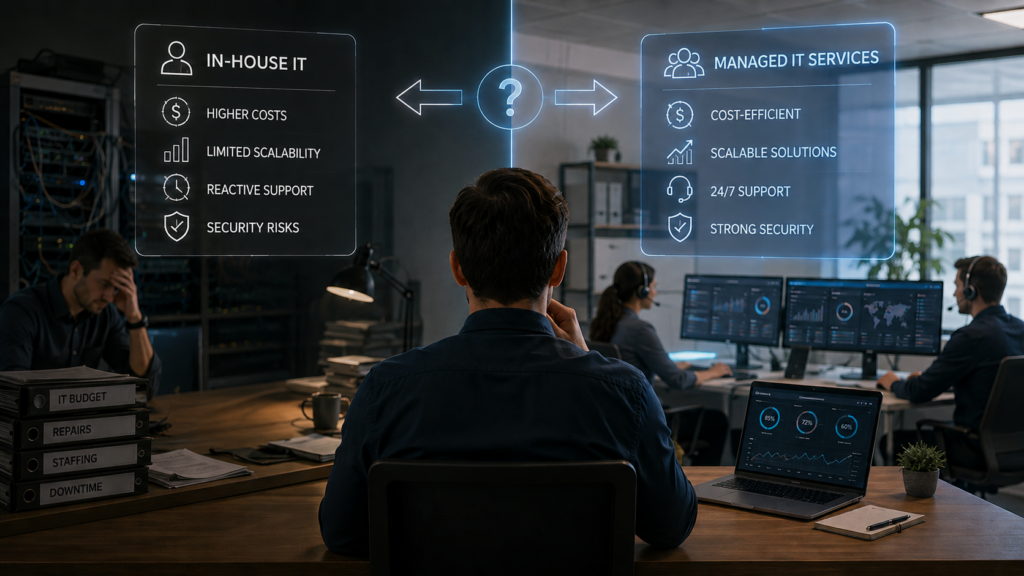
One of the biggest decisions companies face is whether to build an in-house IT team or outsource to managed IT services.
With rising cyber threats, talent shortages, and increasing IT complexity, this decision directly impacts cost, security, and business growth.
Providers like IT Ninjas help businesses move from reactive IT support to proactive managed IT environments.
Quick Answer: In-House IT vs Managed IT
- In-house IT = internal team managing all IT systems
- Managed IT = outsourced experts handling IT support and security
- In-house offers control but higher cost
- Managed IT offers scalability and lower operational expense
- Most SMBs benefit more from managed IT in 2026
What Is In-House IT?
In-house IT refers to a dedicated internal team responsible for managing a company’s entire IT infrastructure.
This includes:
- Hardware and software maintenance
- Network management
- Cybersecurity protection
- Troubleshooting and support
While it provides direct control, it also requires significant investment in salaries, training, and tools.
What Are Managed IT Services?
Managed IT services involve outsourcing IT operations to a specialized provider that monitors, manages, and supports your systems.
Also known as IT outsourcing or MSP (Managed Service Provider) solutions, this model includes:
- 24/7 monitoring
- Cybersecurity management
- Cloud support
- Helpdesk services
- Backup and disaster recovery
Instead of reacting to problems, MSPs prevent them proactively.
Why This Comparison Matters in 2026
Technology has become more complex and business-critical due to:
- Rising ransomware and cyberattacks
- Cloud-first infrastructure adoption
- Remote and hybrid work environments
- AI-driven IT systems
- High demand for IT talent
This makes IT decisions more strategic than ever before.
Cost Comparison
In-House IT Costs:
- Salaries for IT staff
- Employee benefits and training
- Hardware and software tools
- Emergency IT repairs
- Recruitment and turnover costs
Managed IT Costs:
- Fixed monthly subscription
- Scalable per user or device pricing
- No hiring or training costs
- Predictable budgeting
👉 Managed IT is generally more cost-efficient for SMBs.
Security Comparison
In-House IT:
- Limited expertise depending on team size
- Reactive security approach
- Higher risk of missed vulnerabilities
Managed IT:
- Advanced cybersecurity tools
- Continuous monitoring
- Dedicated security experts
- Faster threat detection and response
👉 Managed IT provides stronger enterprise-level security.
Scalability Comparison
In-House IT:
- Difficult to scale quickly
- Requires hiring and onboarding
- Infrastructure upgrades are slow
Managed IT:
- Easily scales with business growth
- Add/remove users instantly
- Flexible service plans
👉 Managed IT wins in scalability.
Performance & Downtime
In-House IT:
- Limited availability (business hours in many cases)
- Slower response during overload
- Higher risk of downtime
Managed IT:
- 24/7 monitoring and support
- Proactive issue prevention
- Faster resolution times
👉 Managed IT reduces downtime significantly.
Expertise & Technology Access
In-House IT:
- Limited to internal skill set
- Requires continuous training
Managed IT:
- Access to full team of specialists
- Latest tools and enterprise systems
- Continuous upgrades included
👉 Managed IT provides broader expertise.
Risks of Choosing the Wrong Model
If You Rely Only on In-House IT:
- High operational costs
- Skill gaps in cybersecurity
- Burnout of IT staff
- Slower innovation
If You Choose Poor MSPs:
- Low-quality support
- Misaligned service expectations
- Security gaps if provider is weak
Hybrid Model (Best of Both Worlds)
Many businesses in 2026 use a hybrid approach:
- Internal IT handles strategic tasks
- MSP handles monitoring, security, and support
This balances control with cost efficiency.
MSP Solution Advantage
A Managed Service Provider like IT Ninjas helps businesses:
- Reduce IT overhead
- Improve cybersecurity posture
- Ensure 24/7 system monitoring
- Support remote and hybrid teams
- Scale IT infrastructure easily
Industry Use Cases
- Healthcare – compliance and patient data security
- Finance – fraud protection and secure transactions
- Legal firms – confidential document protection
- Retail – POS system uptime
- SaaS companies – cloud scalability
- Manufacturing – system reliability
Final Verdict: Which Is Better?
In-house IT is better when:
- You have large enterprise budget
- You need full internal control
- You require highly customized systems
Managed IT is better when:
- You want cost efficiency
- You need scalability
- You require strong cybersecurity
- You want predictable IT expenses
👉 For most SMBs in 2026, managed IT services are the more strategic choice.
Frequently Asked Questions
In-house IT is internal staff, while managed IT is outsourced support.
Yes, it reduces staffing and infrastructure costs.
Managed IT services are usually more efficient and scalable.
Yes, many businesses use a hybrid IT approach.
Conclusion
In 2026, businesses need IT systems that are secure, scalable, and cost-efficient.
While in-house IT provides control, managed IT services offer better flexibility, lower costs, and stronger cybersecurity.
For businesses looking to modernize their IT operations, IT Ninjas provides end-to-end managed IT solutions designed for growth and stability.